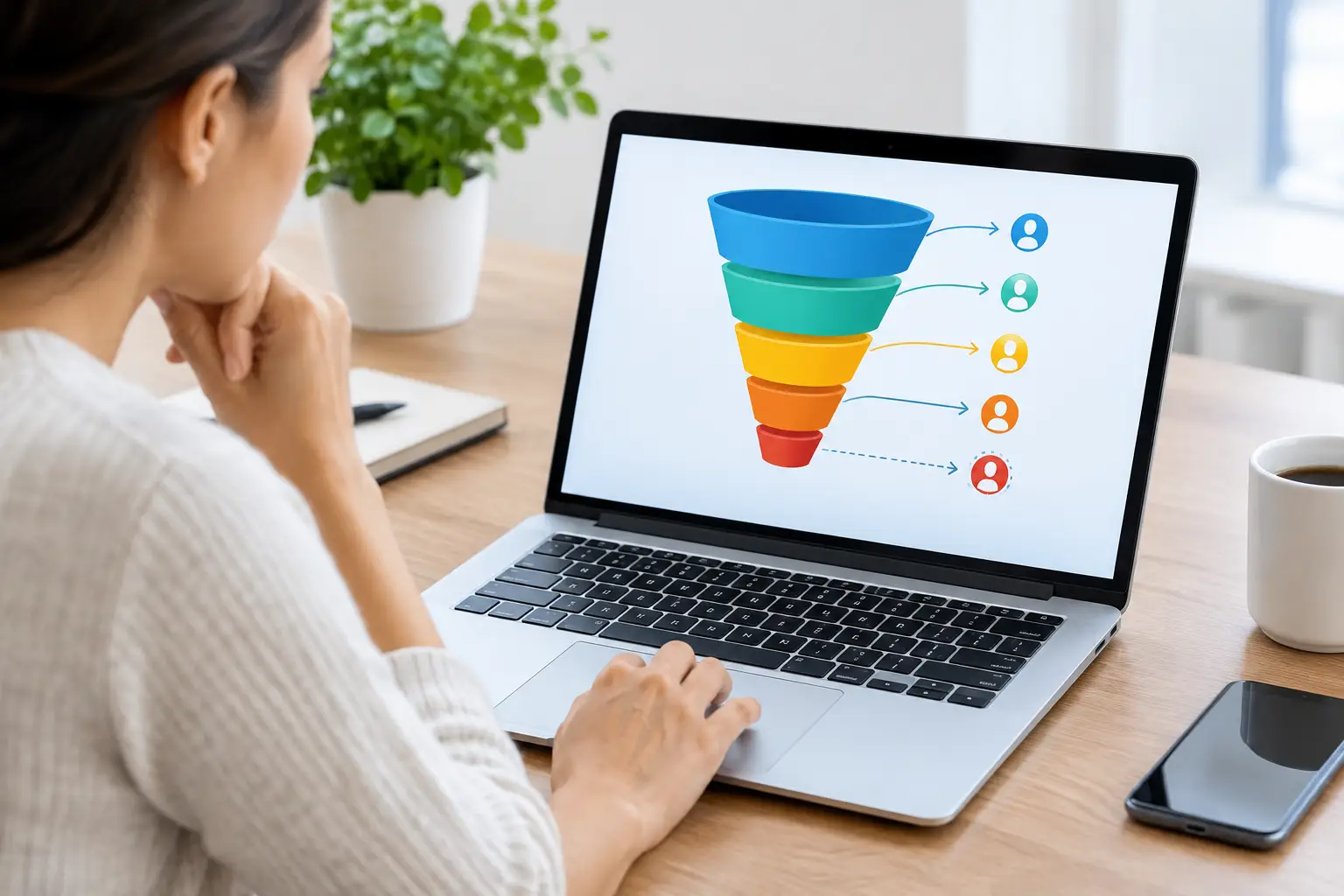
A prospect clicks your affiliate link, reads the offer, reaches checkout, and disappears. That is not just a missed sale. It is a clue. Funnel abandonment analysis helps you identify the exact point where attention turns into hesitation, so you can stop guessing and start fixing the leaks that cost you buyers and commissions.
For digital-product sellers, creators, and affiliates, the goal is not to force every visitor through a purchase. Some traffic will never be qualified. The goal is to find avoidable friction: unclear promises, weak traffic-to-offer alignment, slow pages, surprise pricing, checkout doubts, and follow-up gaps that leave ready buyers without a reason to finish.
What Funnel Abandonment Analysis Actually Measures
A funnel is a sequence of decisions, not just a sequence of pages. Someone sees an ad, email, review, social post, or affiliate promotion. They click. They read the sales page. They may watch a video, select an option, begin checkout, and complete payment. At every stage, they decide whether the next step feels worth it.
Funnel abandonment analysis measures where people stop progressing and looks for the reason behind that behavior. The numbers tell you where the drop happens. Session recordings, page behavior, support messages, surveys, and campaign context help explain why.
Do not confuse a low overall conversion rate with one single problem. A 2% conversion rate can result from excellent targeting and a weak checkout, poor targeting and a strong offer, or a normal mix of both. You need stage-level data before you decide what deserves your time.
A practical starting funnel might track these events:
- Promotional click or landing-page visit
- Sales-page engagement, such as scroll depth or video play
- Click to order form
- Checkout started
- Payment completed
- Upsell accepted or declined
The useful metric is the conversion rate between each step. If 1,000 visitors land on a page, 150 click to order, 90 begin checkout, and 54 buy, the biggest leak is not automatically the first one. You need to compare the drop with your traffic source, price point, offer complexity, and historical baseline.
Start With the Highest-Intent Drop-Off
Not all abandonments have equal value. A visitor who leaves after three seconds may have clicked out of curiosity. A buyer who enters payment details and exits is much closer to revenue. Prioritize the stage where intent is high and the loss is both unusual and fixable.
Sales Page to Checkout
If readers spend time on the page but few click the order button, the offer may not be earning the next step. The headline could be attracting the wrong audience. The benefits may be generic. The price may appear before the value is understood. Or the page may simply ask for too much attention before it explains the core result.
For an affiliate, this often starts before the sales page. If your promo promises “easy passive income” but the offer is a detailed training product requiring work, visitors feel the mismatch immediately. Better pre-selling can reduce low-quality clicks and improve the percentage of visitors who reach checkout.
Test one major message change at a time. Clarify who the product is for, the problem it solves, the format of the solution, and the outcome a buyer can reasonably expect. Specificity beats inflated claims because it helps the right person recognize themselves in the offer.
Checkout Started to Payment Completed
Checkout abandonment deserves close attention because it happens after a prospect has already made a meaningful commitment. Common causes include unexpected pricing, unclear billing terms, insufficient trust, mobile usability problems, rejected payments, or a checkout that asks for information that does not feel necessary.
Review the checkout like a skeptical buyer would. Is the total price visible before the form? Are recurring charges, if any, unmistakably clear? Does the order summary match what the sales page promised? Can a mobile user complete the form without pinching, zooming, or fighting with fields?
A short checkout is usually better, but shorter is not always better. Some offers need a clear refund policy, access details, or billing explanation to reduce anxiety. Remove unnecessary fields, not necessary reassurance.
Payment Completion to Product Access
This stage is often ignored because the sale is technically complete. That is a mistake. If buyers cannot quickly access the product, understand what happens next, or find support, refunds and chargebacks can erase the revenue you worked to earn.
Measure confirmation-page views, login creation, first-product access, and early support requests. A clear post-purchase experience also improves affiliate relationships, because buyers who feel properly served are less likely to blame the referring marketer for confusion.
Use Qualitative Evidence Before You Rewrite Everything
Data can show that 62% of checkout starters leave. It cannot always tell you whether they were worried about price, confused by the payment form, distracted, or unable to use a preferred payment method. That is where qualitative evidence matters.
Watch a sample of anonymized session recordings. Look for rage clicks, repeated scrolling, form-field errors, and moments where users pause at pricing or guarantees. Read customer support tickets and refund requests. Ask recent buyers one simple question: “What almost stopped you from ordering?”
For non-buyers, keep the request even simpler. An exit survey with a few choices can reveal patterns without demanding a long response. Options such as “price,” “not sure it fits my needs,” “need more information,” and “technical issue” are more useful than a vague question alone.
Treat this evidence as directional, not absolute. The loudest complaint is not always the largest conversion barrier. Combine it with funnel data before making a major change.
Segment the Funnel Before Calling It a Problem
A funnel can look broken when the real issue is one traffic segment. Separate performance by source, device, campaign angle, audience type, and returning versus first-time visitor whenever the volume supports it.
Paid traffic may abandon because the ad message overpromises. Email traffic may convert better because subscribers already know you. Mobile visitors may have a dramatically worse checkout rate than desktop visitors. An affiliate campaign may deliver many clicks but weak buyer intent because the bonus angle attracts freebie seekers rather than customers.
This is why averages can mislead. If one source produces 70% of traffic and converts poorly, it can hide a high-converting audience that deserves more attention. Conversely, a strong overall average can conceal a mobile checkout issue that is silently limiting scale.
For WarriorPlus-style promotions, segment by affiliate whenever possible. This is not about blaming partners. It helps identify which promotional messages attract buyers who are aligned with the offer and which messages create curiosity without purchase intent. Share useful conversion insights with affiliates so they can tighten their pre-sell content, bonus positioning, and audience targeting.
Build a Test Plan That Protects Revenue
Once you identify a likely leak, resist the urge to redesign the entire funnel. Large changes make it hard to know what improved performance and can accidentally remove elements that were doing valuable work.
Write a test hypothesis in plain language: “If we show the full price and access details directly above the order button, more qualified visitors will start checkout because there will be less uncertainty.” Then choose one primary metric, such as checkout-start rate, and one guardrail metric, such as refund rate.
Prioritize tests based on impact, confidence, and effort. A payment-form error affecting every mobile buyer is high impact and should move ahead of a minor headline preference. A new color for the call-to-action button may be easy to test, but it rarely deserves priority when the offer-message match is weak.
Give tests enough traffic and enough time to avoid reacting to random variation. If volume is low, use controlled before-and-after comparisons, buyer feedback, and technical audits rather than pretending every small movement is statistically meaningful.
The Follow-Up Funnel Is Part of the Funnel
Many prospects abandon because the timing is wrong, not because the offer is wrong. They get interrupted, compare options, wait for cash flow, or want one more piece of proof. A useful follow-up sequence can recover sales without adding pressure.
Remind prospects what result the product helps them pursue. Address one common objection per message. Reinforce what is included, who it is best for, and what action they can take next. If there is a genuine deadline or limited bonus, state it clearly. Manufactured urgency damages trust and can increase refunds.
For affiliates, follow-up content should add decision-making value rather than repeat the vendor’s headline. A short implementation tip, a realistic use case, or an explanation of who should skip the offer can make your recommendation more credible.
Make Every Leak a Better Decision
The strongest funnel improvements do not come from tricking reluctant visitors into buying. They come from helping qualified prospects make a confident decision with less confusion, less friction, and more relevant proof. Keep reviewing where people leave, listen to what the data and buyers are telling you, and fix the next meaningful obstacle before chasing the next traffic source.